Best open-model use case
Use Wan when your team wants to own the inference path, test custom prompts at scale, keep data closer to your infrastructure, or build a product around open video generation.
Wan is the builder-friendly option.
Wan AI Video
TL;DR: Wan AI video is the strongest 2026 choice for teams that want an open Alibaba video model or a DashScope API route, but Kling is easier when you only need fast hosted product clips.
Wan is unusual because it spans two buying modes. Technical teams can use open Wan2.1 and Wan2.2 model releases for local or private pipelines, while production teams can call Alibaba Cloud Model Studio for text-to-video, image-to-video, and reference-to-video routes.
That flexibility is the main reason Wan deserves attention. It can be a research model, a self-hosted engine, or an API dependency, depending on your team. The tradeoff is that open-model control brings infrastructure complexity.
This review focuses on the commercial decision: when Wan is better than Kling, when the API is safer than self-hosting, and where quality, speed, and hardware cost change the real price of a generated clip.
Direct answer
Wan AI video is excellent for builders, research teams, and companies that need open weights or Alibaba Cloud deployment options. Choose Wan for control, data architecture, and open experimentation; choose Kling for simpler hosted generation; choose Luma or Seedance when a hosted model with less infrastructure overhead fits better.
Wan AI video is excellent for builders, research teams, and companies that need open weights or Alibaba Cloud deployment options. Choose Wan for control, data architecture, and open experimentation; choose Kling for simpler hosted generation; choose Luma or Seedance when a hosted model with less infrastructure overhead fits better.
| Plan or route | Cost signal | Best for | Caveat |
|---|---|---|---|
| Wan open model | Wan2.2 publishes open model weights, including a 5B hybrid route for 720p text-to-video and image-to-video | Teams with GPU capacity, privacy requirements, custom pipelines, research, and repeatable internal tooling | Hardware, engineering time, inference optimization, and maintenance become part of the true cost. |
| Wan API | Alibaba Cloud Model Studio documents Wan text-to-video, image-to-video, reference-to-video, and editing routes | Developers who want hosted generation without running model weights themselves | Region, endpoint, account setup, and async task handling matter for production reliability. |
| Wan quality profile | Strong general motion and open-model transparency rather than a single polished consumer app promise | Custom video products, internal creative tooling, and model experiments where control matters | Out-of-the-box usability can feel rougher than commercial web tools. |
| Wan speed profile | Speed depends heavily on hosted route, GPU class, resolution, and optimization stack | Batch workflows where infrastructure can be tuned over time | A local setup may be slower than a hosted commercial model until optimized. |
| Versus Kling | Kling offers a more straightforward hosted creator path and documented credit costs for VIDEO 3.0 | Marketers, creators, and ecommerce teams that need usable short clips quickly | Kling gives less infrastructure control than an open Wan deployment. |
| Versus Runway or Luma | Runway and Luma package generation inside more mature creative surfaces and plan structures | Teams that value review, editing, billing clarity, and multi-model convenience over self-hosting | You trade some model-level control for operational simplicity. |
Use Wan when your team wants to own the inference path, test custom prompts at scale, keep data closer to your infrastructure, or build a product around open video generation.
Wan is the builder-friendly option.
Use Alibaba Cloud Wan routes when you want programmatic access without running weights. The API path is cleaner for apps that need async jobs, predictable endpoints, and managed availability.
API beats self-hosting for speed to launch.
If you are creating paid social clips today, compare Wan against Kling on the exact same product image. Pick the model that keeps the product accurate with the fewest retries.
Judge by usable clips, not model branding.
Do not compare Wan to Kling until you choose the buying mode. Open Wan is an infrastructure decision; API Wan is a product integration decision.
For product work, use a strong reference frame before testing text-only generation. A locked first image gives Wan less room to drift away from the product.
If running locally, include GPU rental, queue time, engineer time, failed renders, and storage. Open weights are not the same as zero-cost production.
Run the same 5-to-10-second brief through Wan and Kling. Compare identity stability, motion naturalness, generation time, and whether a human editor needs to rescue the result.
Wan AI video refers to Alibaba Tongyi Wanxiang video generation models, including open Wan model releases and hosted Alibaba Cloud Model Studio routes for text-to-video, image-to-video, and reference-to-video.
The Wan-Video organization publishes open Wan model repositories such as Wan2.1 and Wan2.2. Commercial hosted access is separate through Alibaba Cloud Model Studio and related Wan APIs.
Wan is better when open weights, infrastructure control, or Alibaba Cloud integration matter. Kling is usually easier for creators and marketers who want hosted short video generation with less setup.
Use Wan if you are a developer, research team, enterprise AI group, or media tool builder. For simple social video production, compare Wan against Kling or Luma before committing.
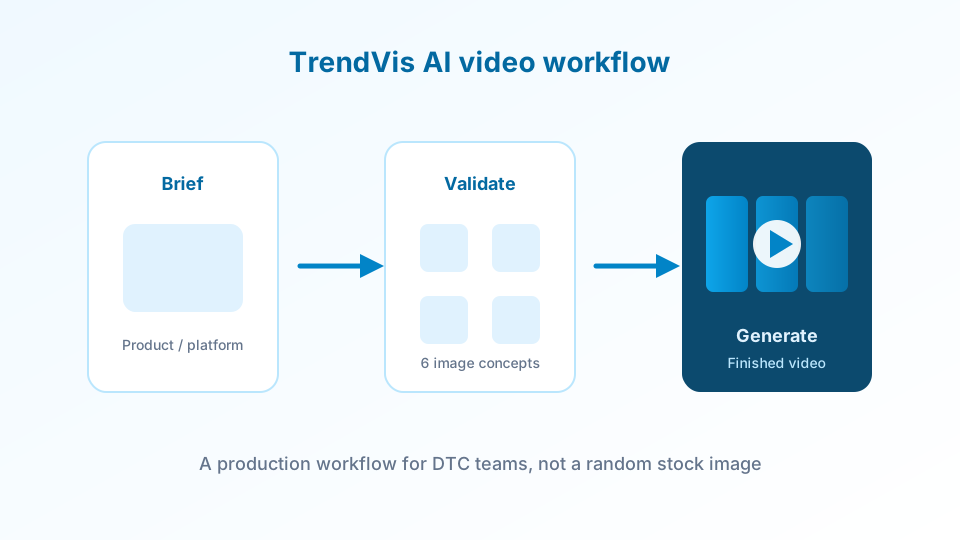
TrendVis turns product briefs into creative angles, validates them as images, then upgrades only the best concept to video.
Start in the studio