Best for 16:9 product B-roll
Use Runway, Kling, or Luma when you need a clean horizontal product shot, camera push, reveal, ingredient scene, or abstract visual for a YouTube segment.
Generate short 16:9 shots and edit them into the video.
Best AI Video for YouTube
TL;DR: the best AI video generator for YouTube is a shot workflow, not a one-click long-form machine. Use AI tools for scenes, B-roll, intros, thumbnails, and visual hooks, then edit the full video normally.
Most top AI video models still generate short clips measured in seconds. Runway Gen-4 help lists 5 or 10 second outputs. Kling 3.0 promotes up to 15 seconds. Luma Ray guidance often uses 5 or 10 second durations. That matters for YouTube.
This page compares Runway, Kling, Luma, Pika, and Veo by 16:9 fit, long-form assembly, YouTube disclosure rules, commercial safety, and whether the tool helps creators make videos people will actually watch.
Direct answer
The best AI video generator for YouTube is not one long single-render tool. Use Runway or Kling for short cinematic shots, Luma for controlled clips, Pika for social effects, and an editor for assembly. For long-form YouTube, plan scenes, rights, narration, and disclosure first.
The best AI video generator for YouTube is not one long single-render tool. Use Runway or Kling for short cinematic shots, Luma for controlled clips, Pika for social effects, and an editor for assembly. For long-form YouTube, plan scenes, rights, narration, and disclosure first.
| Plan or route | Cost signal | Best for | Caveat |
|---|---|---|---|
| Runway | Free credits are limited; paid plans add more credits and workflow features for repeat video work | 16:9 cinematic shots, product B-roll, intro visuals, scene transitions, and short ad-style clips | Gen-4 is built for 5 or 10 second shots, so long-form YouTube requires many clips and editing. |
| Kling | Free testing exists with watermark limits; paid membership and credits are better for clean YouTube publishing | Motion-heavy product shots, character clips, native audio experiments, and short story beats | Kling 3.0 promotes up to 15 seconds, which still means long-form needs scene assembly. |
| Luma | Luma paid individual plans start with Plus and scale to Pro and Ultra for more usage | Controlled cinematic clips, camera movement, short visual sequences, and creator workflows | Check aspect ratio, rights, watermark, and export details in your account before building a channel workflow. |
| Pika | Pika offers free and paid plans, with export rights and watermarks depending on plan rules | Short social effects, meme-like sections, visual hooks, Shorts, and quick scene experiments | Pika is better for moments and effects than complete long-form production. |
| Veo and YouTube tools | Veo access depends on Google product surface and plan; YouTube also applies AI labels for realistic generated content | YouTube-native experiments, Shorts, B-roll, and realistic scene generation when access is available | Disclosure rules matter. Realistic AI content may need labels and can be auto-detected. |
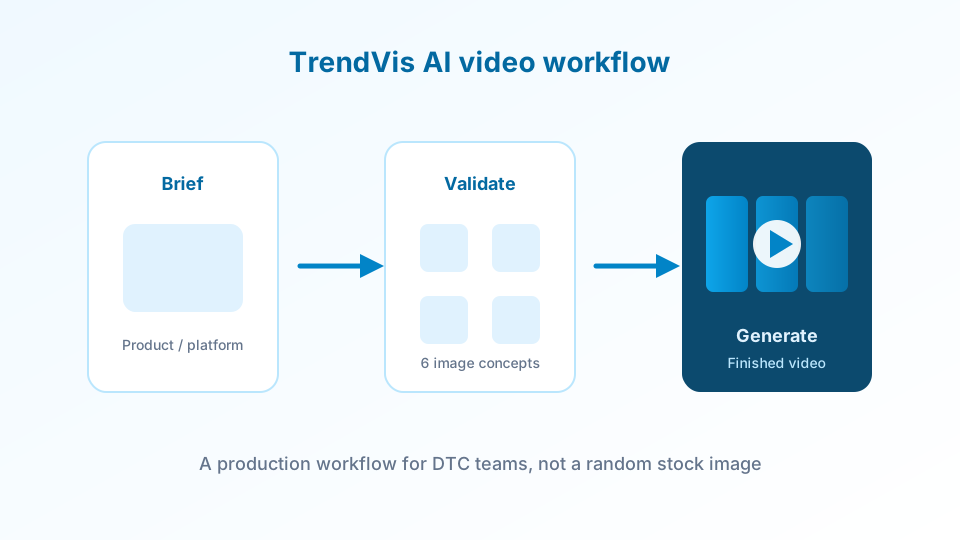
| TrendVis workflow | TrendVis helps plan, validate, and route product visuals before spending credits on video generation | YouTube creators and DTC teams building hooks, product demos, thumbnails, and short scenes around real offers | It is a planning and creative workflow layer, not a replacement for editing, voice, retention, or channel strategy. |
Use Runway, Kling, or Luma when you need a clean horizontal product shot, camera push, reveal, ingredient scene, or abstract visual for a YouTube segment.
Generate short 16:9 shots and edit them into the video.
No leading generator should be treated as a one-click four-minute creator. Build an outline, generate clips by scene, record narration, then edit pacing manually.
Long-form is assembly, not one prompt.
YouTube requires disclosure for realistic AI that meaningfully alters or generates photorealistic content. That means the best tool is the one your workflow can label and document.
Plan disclosure before upload day.
Start with the title, hook, outline, proof points, product claims, and call to action. AI clips should support the story, not replace it.
Create separate clips for intro, problem, product, proof, result, and call to action. Short clips are easier to repair, reorder, and cut.
A YouTube long-form video usually needs 16:9 framing. Shorts may need vertical. Do not force one generation to serve both if composition matters.
Keep a record of the tool, prompt, source references, music, voice, and whether the clip depicts realistic people, places, or events.
Runway and Kling are strong for short cinematic shots, Luma is useful for controlled clips, Pika is good for effects, and TrendVis helps plan product-focused scenes.
Not reliably as one clean generation. Build long-form YouTube videos from short AI clips, narration, editing, captions, music, and human structure.
YouTube requires creators to disclose realistic AI content that meaningfully alters or generates photorealistic people, places, scenes, or events.
Use 16:9 for long-form YouTube and 9:16 for Shorts. Generate separately when composition matters, because cropping can weaken the shot.
TrendVis turns product briefs into creative angles, validates them as images, then upgrades only the best concept to video.
Start in the studio