Best first pick: Luma
Choose Luma when your goal is to understand AI video without a long setup. Upload an image, keep motion simple, and learn what the model changes between frames.
Best for the first hour of learning.
Beginner AI Video Tools
TL;DR: the best AI video generator for beginners is Luma if you want the simplest first run, Kling if you want to learn motion control, and Runway if editing tools matter too.
A beginner-friendly AI video tool is not the one with the most buttons. It is the one that helps you make a usable five or ten second clip without forcing you to understand seed values, motion weights, prompt syntax, or model routing on day one.
For most new creators, the safest path is image-to-video. Create or upload a still frame, describe a simple motion, render a short clip, then judge the result. Text-to-video is fun, but it is harder for beginners because the model must invent the whole scene.
Direct answer
The best AI video generator for beginners is Luma for the smoothest first session, Kling for learning motion control, Runway for people who also need editing, and Seedance for reference-led control. Start with short image-to-video tests before paying for longer clips.
The best AI video generator for beginners is Luma for the smoothest first session, Kling for learning motion control, Runway for people who also need editing, and Seedance for reference-led control. Start with short image-to-video tests before paying for longer clips.
| Plan or route | Cost signal | Best for | Caveat |
|---|---|---|---|
| Luma Dream Machine | Free plan is limited; paid web plans start at Lite and Plus tiers | The first successful image-to-video clip with the least setup friction | The easiest start is not always the cheapest path once you need higher resolution or more volume. |
| Kling AI | Free testing path plus credit-based paid plans that vary by market and offer | Learning camera movement, character motion, image-to-video, and repeatable social clips | Queues, watermarks, and exact free credit amounts can change, so check the live app before planning. |
| Runway | Free gives 125 one-time credits; Standard starts at $12/user/month billed annually | Beginners who want generation plus editing, asset storage, audio tools, and templates | More tools can slow a pure beginner who only needs one fast clip. |
| Seedance 2.0 | Pricing depends on provider; Luma lists Seedance 2.0 credit costs by resolution | Users who want reference images, audio/video references, and more direction over the scene | It is powerful, but the control surface can feel less obvious than Luma or Kling at first. |
| Hailuo AI | Free trial credits plus paid Hailuo plans from MiniMax and partner routes | Fast social clips, character motion, product shots, and low-cost experiments | Quality can be strong, but the app can feel more model-first than workflow-first. |
| TrendVis | TrendVis plans start at $29/month with image and video workflow credits | Beginners who want prompts, angles, model choice, and image validation handled in one flow | It is built for product and social creative, not every film or art use case. |
Choose Luma when your goal is to understand AI video without a long setup. Upload an image, keep motion simple, and learn what the model changes between frames.
Best for the first hour of learning.
Choose Kling once you want more say over movement. It teaches the ideas that matter later: image anchoring, motion direction, duration, and prompt clarity.
Best for learning how motion really works.
Choose Runway if the generated clip is only one part of the job. Its value grows when you also need editing, assets, apps, and finishing.
Best when generation and editing sit together.
A reference image gives the model a clear subject, lighting, and frame. Beginners get fewer strange scene changes when the first frame is already decided.
Use a simple prompt like slow push-in, hand turns product, or steam rises. Multi-action prompts are where beginner clips often break.
Short clips teach faster because you can compare results without spending many credits. Longer clips should wait until the motion is stable.
Once a short clip works, regenerate at a better setting or move to a stronger model. This keeps beginner learning cheap and calm.
Luma is the easiest first pick for many beginners because the image-to-video path is simple and the interface does not force many technical choices before the first render.
Image-to-video is safer for beginners. A still image locks the subject and frame, while text-to-video asks the model to invent too much at once.
Runway is good for beginners who also want editing tools. If you only want one quick clip, Luma or Kling may feel easier at the start.
Buy none at first if a free test path is available. Run three to five short clips, learn which model fits your style, then pay only when you need no watermark or more volume.
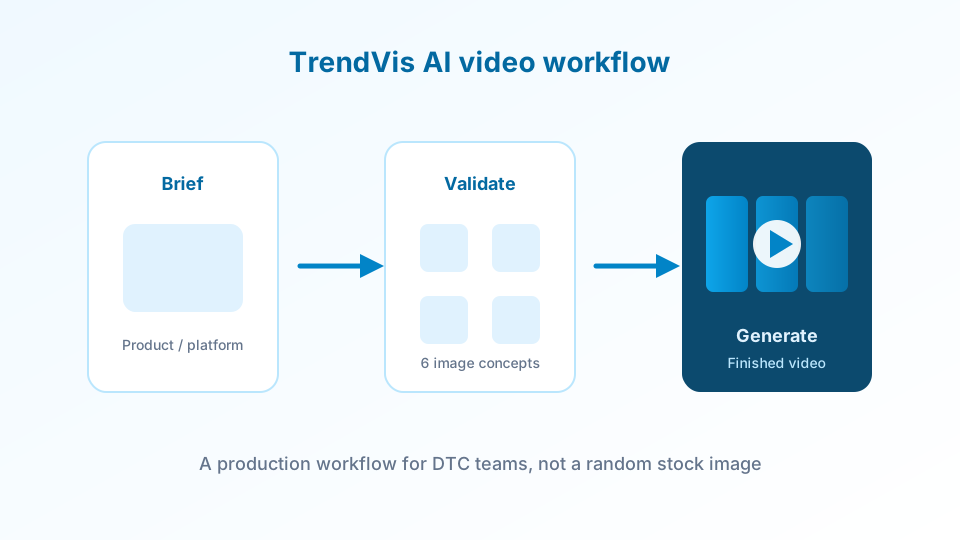
TrendVis turns product briefs into creative angles, validates them as images, then upgrades only the best concept to video.
Start in the studio