Upgrade for consistency
Gen-4 is most valuable when a product, character, room, or campaign look must stay recognizable across a shot. That consistency is the upgrade reason.
Pay for Gen-4 when continuity affects trust.
Runway Gen-4
TL;DR: Runway Gen-4 is worth using when consistency, controllable image-to-video, and cleaner commercial shots matter. It is less convincing if you expect one prompt to create a finished long video.
Runway Gen-4 is built around short generated shots. Runway help says Gen-4 creates 5 or 10 second videos from an input image and text prompt, while Turbo is positioned as a faster, lower-cost iteration path.
This review compares Gen-4, Gen-4 Turbo, Gen-3 Alpha, free credits, paid plans, and image-first testing so marketers can decide when the upgrade cost actually improves a campaign.
Direct answer
Runway Gen-4 is worth upgrading when you need better identity consistency, controllable image-to-video, and cleaner short commercial shots. Stay on Gen-3 Alpha or Gen-4 Turbo for rough tests if cost matters more than final polish, because Gen-4 is still built for shots, not full scenes.
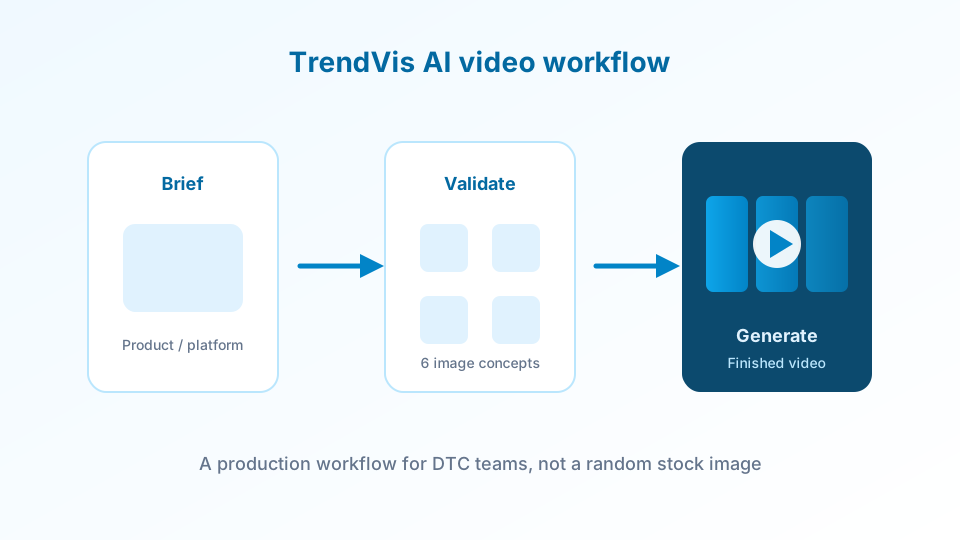
Runway Gen-4 is worth upgrading when you need better identity consistency, controllable image-to-video, and cleaner short commercial shots. Stay on Gen-3 Alpha or Gen-4 Turbo for rough tests if cost matters more than final polish, because Gen-4 is still built for shots, not full scenes.
| Plan or route | Cost signal | Best for | Caveat |
|---|---|---|---|
| Runway Free | Free includes 125 one-time credits, listed as 25 seconds of Gen-4 Turbo or 25 image generations | Testing the interface, short image-to-video prompts, and deciding whether Runway fits your style | Free credits do not refresh monthly and are not enough for repeat production. |
| Runway Gen-4 | Available through paid Runway access and credits, with 5 or 10 second generation lengths in the Gen-4 help docs | Short hero shots, product motion, character continuity, controlled camera moves, and final-quality campaign clips | It is a shot generator. Longer videos require planning, multiple clips, editing, and audio work. |
| Runway Gen-4 Turbo | Runway positions Turbo as faster and lower cost than the main Gen-4 path | Iteration, prompt tests, rough cuts, social concepts, and choosing which idea deserves a final render | Use Turbo for learning and filtering ideas, not every final shot. |
| Gen-3 Alpha and older routes | Older routes can still be useful where available, especially when the job is a rough test rather than a final asset | Fast drafts, old workflows, concept exploration, and teams that already know Gen-3 prompt behavior | Identity and object consistency are the main reasons to move toward Gen-4. |
| Runway paid plans | Runway sells Free, Standard, Pro, Max, and Enterprise options with credits, storage, and plan limits | Teams that need more credits, watermark removal, storage, faster work, and repeat campaign output | The plan price is only half the budget; failed generations can spend credits quickly. |
| TrendVis workflow | TrendVis validates product frames as stills before sending only the best concept into video | DTC marketers who want fewer failed Runway renders and stronger image references before motion | TrendVis helps choose and prepare the shot. Runway still determines the final video behavior. |
Gen-4 is most valuable when a product, character, room, or campaign look must stay recognizable across a shot. That consistency is the upgrade reason.
Pay for Gen-4 when continuity affects trust.
Before spending on final-quality renders, test motion, framing, and prompt language with cheaper or faster routes. Most bad ideas can be rejected in draft form.
Draft cheap, finish only the winner.
Runway Gen-4 outputs short clips. A YouTube ad, product explainer, or longer story needs shot planning, assembly, voice, captions, and post-production.
Think in shots, not whole films.
Image-to-video quality depends on the reference. Use a clean product frame with clear subject, simple background, and visible edges before adding movement.
Short prompts should describe the camera, subject motion, pacing, and what must remain unchanged. Avoid asking for too many actions in one clip.
Run the same frame and prompt through the routes you can access. Pick based on product accuracy, motion, cost, and how many retries are needed.
Assemble short clips in an editor, add brand-safe audio, captions, claims, and final crop. Treat Runway as the shot engine, not the entire publishing system.
Runway Gen-4 is best for short controllable image-to-video shots where identity, product shape, camera motion, and visual consistency matter.
Runway help says Gen-4 creates videos in 5 or 10 second durations from an input image and text prompt.
Gen-4 is the better choice for consistency and final-quality short shots. Gen-3 Alpha or Turbo-style routes can still be useful for draft tests and cheaper iteration.
Yes when the video will ship as an ad or product clip. For early brainstorming, use lower-cost drafts and upgrade only the frames that already work as stills.
TrendVis turns product briefs into creative angles, validates them as images, then upgrades only the best concept to video.
Start in the studio