When Ideogram wins
Pick Ideogram for any asset where the words are visible to the audience. That includes posters, sale graphics, ad thumbnails, packaging ideas, book covers, and signage.
The copy is the reason to choose Ideogram.
Ideogram AI Review
TL;DR: Ideogram AI is the best image generator to test first when the image must contain readable words, labels, signs, logos, posters, or ad headlines.
Ideogram AI has a clear lane in the image market. It is not only a pretty-picture generator; it is built for layouts where text, graphic design, product labels, and campaign messages need to survive generation without turning into nonsense.
The 2026 version matters because Ideogram 4.0 pushes the text-in-image advantage into a broader design workflow: prompt fidelity, editing, transparent backgrounds, upscaling, reframe, layer tools, app use, API use, and open-weight options for teams that need more control.
Direct answer
Ideogram AI is the best 2026 pick for text in images, posters, labels, thumbnails, and ad mockups. Midjourney still wins many style tasks, and GPT image models remain stronger all-purpose tools, but Ideogram is the first test when readable words matter.
Ideogram AI is the best 2026 pick for text in images, posters, labels, thumbnails, and ad mockups. Midjourney still wins many style tasks, and GPT image models remain stronger all-purpose tools, but Ideogram is the first test when readable words matter.
| Plan or route | Cost signal | Best for | Caveat |
|---|---|---|---|
| Text rendering | Ideogram 4.0 is positioned around crystal-clear type and stronger prompt alignment | Ad headlines, event posters, product labels, storefront signs, stickers, thumbnails, and print-on-demand concepts | It still needs short copy and simple layouts; asking for dense paragraphs inside one image is risky. |
| Image quality | API quality tiers run from 4.0 Turbo at $0.03 to 4.0 Quality at $0.10 per image | Teams that want predictable per-image pricing and can choose speed or quality by job | The app plan price can differ from API cost, so production buyers should check both. |
| Editing workflow | Ideogram supports edit, remix, reframe, replace background, transparent generation, upscale, and layerize routes | Iterating a campaign layout after the first image instead of starting over each time | Editing tools help most when the starting design is already close to the brief. |
| Versus Midjourney | Midjourney starts at $10 monthly and is stronger for premium style and mood | Use Midjourney for taste-led art direction and Ideogram for words, layouts, and graphic assets | Midjourney can produce beautiful text sometimes, but Ideogram is the safer first pick for copy. |
| Versus GPT image | OpenAI image generation is token priced and strong for broad prompt following and edits | Use GPT image models for general scenes, product logic, and image edits; use Ideogram when the text is the job | The broadest model is not always the best specialist. |
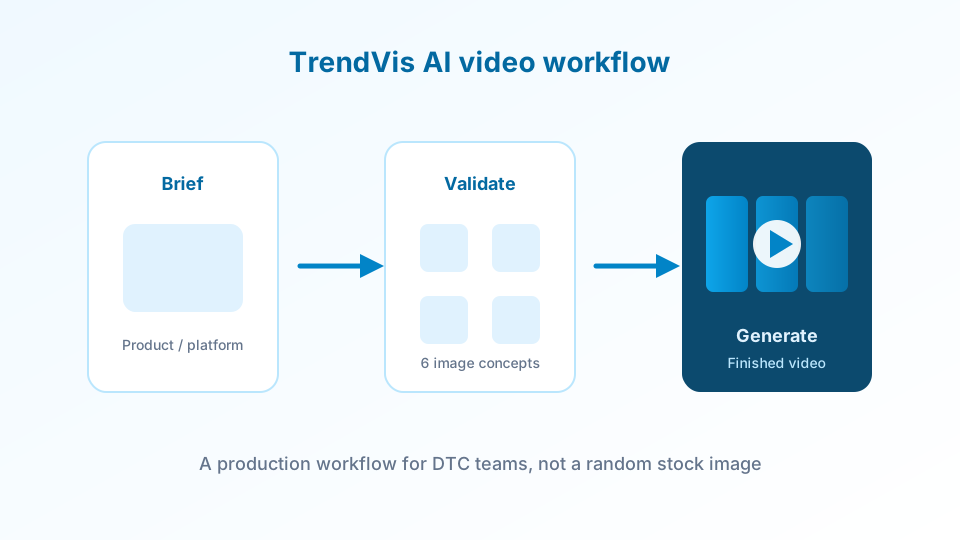
| TrendVis fit | TrendVis uses image concepts to validate ad angles before video spend | DTC teams testing product claims, hooks, poster-like ads, and social thumbnails before motion | TrendVis adds workflow, scoring, and routing around the generator rather than replacing Ideogram. |
Pick Ideogram for any asset where the words are visible to the audience. That includes posters, sale graphics, ad thumbnails, packaging ideas, book covers, and signage.
The copy is the reason to choose Ideogram.
Pick Midjourney when the asset is mainly about mood, lighting, texture, fashion style, cinematic tone, or a brand world with little text inside the picture.
Use Midjourney when taste matters most.
Pick GPT image models when the prompt has many constraints, the subject needs logical consistency, or the image will be edited through several rounds.
Use GPT image for broad creative reliability.
Keep the text short, exact, and easy to inspect. Ideogram performs best when the prompt asks for one clear headline or label rather than a crowded layout.
Use Ideogram to test multiple arrangements: centered headline, label on product, poster headline, sign text, or thumbnail copy.
TrendVis checks whether the text is readable, spelled correctly, and placed where the ad needs it. A pretty image with wrong words fails the job.
If the image will become a video, use the best text-safe still as the reference. This lowers the chance that motion breaks the message.
Ideogram AI is best for images that contain readable text: posters, signs, packaging mockups, thumbnails, ads, stickers, store graphics, and campaign layouts.
Ideogram is better when text accuracy is the main requirement. Midjourney is often better for premium style, art direction, lighting, and mood-heavy visuals.
Ideogram lists 4.0 API pricing at $0.03 per image for Turbo, $0.06 for Default, and $0.10 for Quality. Extra features such as transparent output, upscale, and layerize have separate prices.
Ideogram can draft logo-like concepts and text marks, but final brand logos still need human review for originality, trademark risk, vector cleanup, and layout polish.
TrendVis turns product briefs into creative angles, validates them as images, then upgrades only the best concept to video.
Start in the studio