Use schnell for speed
Schnell is useful when the team needs many rough options quickly. It is a good first pass for composition, hook testing, and mood before choosing a final route.
Best when speed beats polish.
Flux AI Image
TL;DR: Flux AI image generation is the best choice when you want strong image quality with developer control, open-weight options, and cheaper batch testing than many closed web apps.
Flux is not one product experience. It is a model family from Black Forest Labs that can show up through the BFL API, third-party hosts, local workflows, and open-weight model routes such as FLUX.1 schnell and FLUX.1 dev.
That makes Flux attractive for teams that care about cost, repeatable pipelines, and control. It also means the buyer has to choose the right path: schnell for speed, dev for open experimentation, pro or newer BFL hosted models for higher quality and easier production use.
Direct answer
Flux AI image generation is best for teams that need speed, API control, lower batch cost, and open-weight flexibility. Use schnell for fast drafts, dev for controllable research and local workflows, and pro or hosted BFL routes when quality matters more than setup.
Flux AI image generation is best for teams that need speed, API control, lower batch cost, and open-weight flexibility. Use schnell for fast drafts, dev for controllable research and local workflows, and pro or hosted BFL routes when quality matters more than setup.
| Plan or route | Cost signal | Best for | Caveat |
|---|---|---|---|
| FLUX.1 schnell | Open-weight route focused on speed; cost depends on local hardware or chosen API host | Fast drafts, batch concepting, thumbnails, prompt tests, and low-cost creative exploration | It is the speed route, so final polish may need a stronger Flux model or another image model. |
| FLUX.1 dev | Open-weight 12B model for noncommercial or license-aware development routes | Local workflows, ComfyUI pipelines, research, controlled experiments, and technical users | Open-weight control comes with setup, hardware, hosting, and license responsibility. |
| Flux Pro and BFL API | BFL pricing is pay-as-you-go with no seat fee, covering current hosted Flux image models | Production teams that want Flux quality without running infrastructure themselves | The hosted model menu changes, so check the live BFL pricing page before planning volume. |
| Flux versus Midjourney | Midjourney starts at $10 monthly and is subscription based with GPU time | Flux for pipelines and cost control; Midjourney for fast premium art direction in a web product | Midjourney is often easier for nontechnical creators; Flux is stronger when workflow control matters. |
| Flux versus Ideogram | Ideogram API lists clear per-image prices and is stronger for text-heavy image tasks | Flux for general image pipelines; Ideogram for posters, labels, signs, and type-led layouts | Flux can make good text in some cases, but Ideogram is safer when words must be exact. |
| TrendVis image validation | TrendVis uses still images to test ad concepts before video render spend | Running Flux-like draft frames through a product-ad workflow and upgrading only winners | TrendVis routes creative decisions; the best source model still depends on the asset job. |
Schnell is useful when the team needs many rough options quickly. It is a good first pass for composition, hook testing, and mood before choosing a final route.
Best when speed beats polish.
Dev is the route for teams comfortable with local or hosted pipelines. It fits workflows where repeatability, adapters, and lower unit cost matter.
Best when the team owns the pipeline.
Hosted Flux routes are better when you want reliable access without maintaining GPUs. They fit product teams that need results, not infrastructure work.
Best when quality and convenience matter.
Do not start by asking whether Flux is good. Start by choosing speed, control, or production quality. The model route should match that priority.
TrendVis encourages broad still-image testing before video. Flux is useful here because lower-cost routes can create many candidate frames.
Score whether the generated image keeps the product shape, materials, label area, and offer clear. A stylish but inaccurate product frame is not usable.
Once a Flux frame wins, move it into editing, upscaling, or video generation. This keeps expensive renders tied to proven creative direction.
Flux AI image generation refers to the Black Forest Labs Flux model family, including open-weight and hosted image generation routes used for text-to-image and image editing workflows.
Schnell is the speed-focused route, dev is the open-weight development route, and pro or hosted BFL routes are better for higher-quality production access.
Flux is better when API control, open-weight workflows, lower-cost batching, or local pipelines matter. Midjourney is better for simple web use and high-style art direction.
Some Flux weights are open, but practical use still has costs: hardware, hosting, API fees, storage, and engineering time. Hosted BFL access is pay-as-you-go.
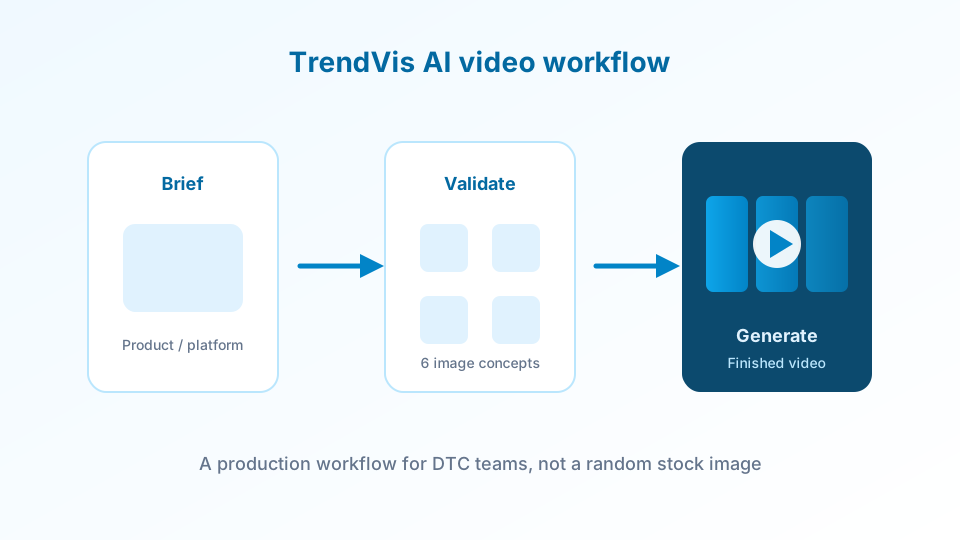
TrendVis turns product briefs into creative angles, validates them as images, then upgrades only the best concept to video.
Start in the studio