Best Kling use case
Start with an approved product image, then ask for one realistic motion: a hand turn, a slow push-in, a fabric move, a pour, or a camera drift.
Kling shines when the source frame is strong.
Kling AI Review
TL;DR: Kling AI is one of the best 2026 video generators for realistic motion, image-to-video, and social product clips, especially when you need believable movement more than a full editing suite.
Kling AI has become a serious choice for marketers and creators because it handles short motion better than many tools at the same cost level. The strongest use cases are product movement, human action, camera moves, fashion clips, lifestyle shots, and image-to-video ads.
This Kling AI review focuses on what matters for production: quality, motion stability, pricing, speed, resolution, native audio, and when to choose Kling over Runway, Luma, Pika, or another image-to-video workflow.
Direct answer
Kling AI is worth testing in 2026 if your priority is realistic short-form motion, image-to-video product clips, and cost-aware social video. Choose Runway for editing control, Luma for credit-transparent Ray workflows, and Pika for faster effects-led social variants and creator formats.
Kling AI is worth testing in 2026 if your priority is realistic short-form motion, image-to-video product clips, and cost-aware social video. Choose Runway for editing control, Luma for credit-transparent Ray workflows, and Pika for faster effects-led social variants and creator formats.
| Plan or route | Cost signal | Best for | Caveat |
|---|---|---|---|
| Kling VIDEO 3.0 no audio | Official guide lists 6 credits per second at 720p and 8 credits per second at 1080p | Silent product ads, image-to-video tests, motion clips, and social creative where audio is added later | A 10-second 1080p no-audio clip consumes 80 credits before retries. |
| Kling VIDEO 3.0 native audio | Official guide lists 9 credits per second at 720p and 12 credits per second at 1080p | Clips where native sound, speech, or synced audio are part of the creative idea | Native audio raises cost and should be saved for concepts that already work visually. |
| Voice control add-on | Kling lists voice control at 2 extra credits per second | Character, narrator, and voice-tone experiments that need more audio direction | Only add voice control when the output needs it; otherwise it increases burn without improving visuals. |
| Motion quality | Kling is strongest when motion realism is the buying reason | Walking, fabric movement, camera travel, product handling, texture motion, and short action beats | Hands, fast cuts, and crowded scenes still need retries and human review. |
| Versus Runway | Runway Standard starts at $12 monthly annual, and API video models charge credits per second | Use Kling first for motion value; use Runway when editing tools and suite workflow are needed | Runway can be the better final workspace even when Kling is the better first motion test. |
| Versus Luma | Luma lists Plus at $30 monthly and publishes credit costs for Ray, Kling, Seedance, and other routes | Use Luma when transparent cost tables and multi-model routing matter to the team | Kling inside another platform may price differently from Kling direct access. |
Start with an approved product image, then ask for one realistic motion: a hand turn, a slow push-in, a fabric move, a pour, or a camera drift.
Kling shines when the source frame is strong.
Complex multi-character scenes, very fast motion, tiny text, exact logos, and long narrative continuity can still break. Keep social clips short and inspect frame by frame.
Short, clear prompts beat ambitious scenes.
Draft no-audio clips at lower settings, pick the best motion, then upgrade duration, resolution, or native audio only after the clip proves the creative idea.
Spend credits after the motion works.
TrendVis begins with a still frame because image-to-video quality depends on the starting frame. Bad product framing becomes worse once motion begins.
Kling performs better when the prompt has one subject, one motion, and one camera idea. Long prompt stacks make failure harder to diagnose.
Check whether the product stays accurate, then judge whether the motion feels natural. A beautiful move is useless if the product changes shape.
Test Kling against Runway, Luma, or Pika for valuable clips. The best model is the one that produces the most usable output per credit.
Yes. Kling AI is a strong 2026 pick for realistic short-form motion, image-to-video clips, product movement, fashion shots, lifestyle scenes, and social ads.
Kling lists VIDEO 3.0 no-audio generation at 6 credits per second for 720p and 8 credits per second for 1080p. Native audio costs 9 or 12 credits per second, depending on resolution.
Kling can be better for affordable realistic motion and image-to-video tests. Runway is better when you need editing tools, asset storage, broader apps, and a full creative workspace.
Start from a strong still image, request one clear motion, render a short no-audio draft first, then upgrade resolution, length, or audio only after the motion works.
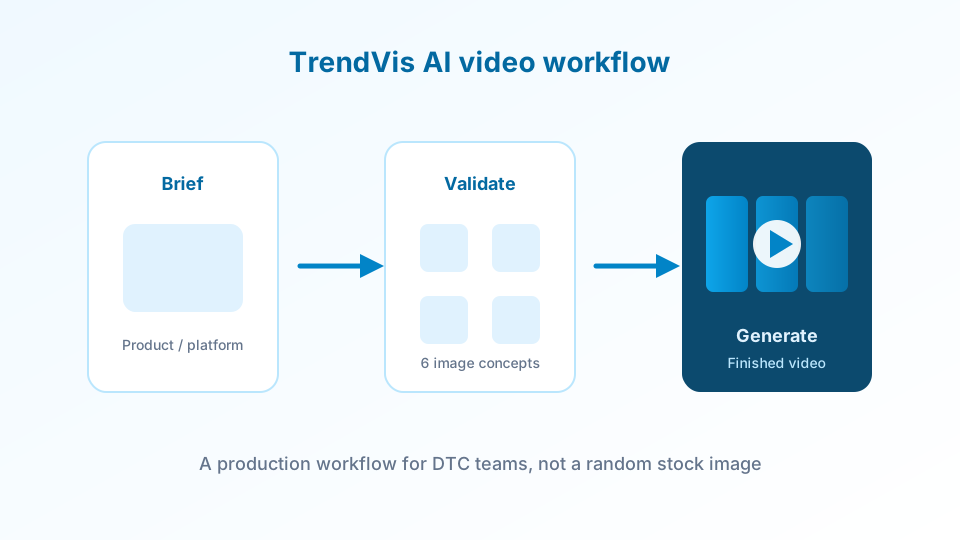
TrendVis turns product briefs into creative angles, validates them as images, then upgrades only the best concept to video.
Start in the studio