Best Seedance use case
Use Seedance for short social clips where motion should feel natural, the reference image matters, and audio or multimodal context can improve the final scene.
Seedance shines with reference-led movement.
Seedance AI Review
TL;DR: Seedance AI is one of the strongest 2026 video generators for natural motion and reference-led scenes, but buyers should confirm access and pricing through the platform where they will actually generate.
ByteDance positions Seedance 2.0 as a multimodal video model with audio-video joint generation, motion stability, and support for images, audio, and video as references. That makes it especially interesting for creators who need more than a single text prompt.
The model is compelling because it targets a real production pain: natural motion without losing creative control. In product and social clips, the best Seedance outputs feel less stiff than many budget video tools.
This review covers Seedance quality, cost signals, where it beats Kling, where Kling is still easier, and how to test Seedance inside a model-comparison workflow before committing a campaign around it.
Direct answer
Seedance AI is worth testing when natural motion, multimodal references, and audio-video generation matter. It is especially strong for social video concepts and reference-led creative. Kling remains simpler for many hosted product clips, while Luma can be better for transparent credit comparison and budget planning.
Seedance AI is worth testing when natural motion, multimodal references, and audio-video generation matter. It is especially strong for social video concepts and reference-led creative. Kling remains simpler for many hosted product clips, while Luma can be better for transparent credit comparison and budget planning.
| Plan or route | Cost signal | Best for | Caveat |
|---|---|---|---|
| Seedance 2.0 capability | ByteDance highlights motion stability, audio-video joint generation, and multimodal references | Scenes that need controlled motion, audio context, character reference, or richer creative direction | Availability and feature exposure depend on the app, API, or platform route used. |
| Low-cost testing | Seedance is often positioned as a cost-aware route, especially through platforms that offer fast variants | Early motion exploration, social clips, and teams testing many short variants | The cheapest route may reduce quality, duration, or control. |
| Quality profile | Best results show natural motion, camera control, and stronger reference following than many older models | Fashion, people, lifestyle, creator videos, and product scenes with a clear reference image | Complex hands, exact logos, text, and crowded scenes still require review. |
| Versus Kling | Kling is more straightforward for many hosted short-form image-to-video jobs | Product movement, realistic short clips, and teams that want direct credit rules | Seedance may win when multimodal reference control or natural social motion matters more. |
| Versus Luma | Luma publishes Seedance route costs alongside other model routes in its credit table | Teams that want to compare Seedance, Kling, Veo, and Ray with one budgeting surface | Platform pricing may differ from direct or regional access. |
| Versus Runway | Runway emphasizes a full production workspace around video generation | Teams needing editing, asset review, and a supported creative suite | Seedance may be more compelling as a model choice than as an all-in-one workspace. |
Use Seedance for short social clips where motion should feel natural, the reference image matters, and audio or multimodal context can improve the final scene.
Seedance shines with reference-led movement.
Like every current video model, Seedance can miss exact product details, hands, small text, and continuity in complex scenes. Keep the first test short and focused.
Simple scenes still win.
Use a fast or lower-cost route to discover viable motion, then spend on the higher-quality route only after the source image and prompt are already working.
Do not buy quality before direction.
Seedance is most interesting when it can use image, video, or audio context. Provide a clean product frame or character reference before asking for motion.
Natural movement degrades when the prompt asks for too many simultaneous actions. Use one subject, one camera move, and one visible product behavior.
Kling may win for product realism, while Seedance may win for social motion or multimodal control. Test the same source image instead of comparing demos.
Seedance pricing and limits can vary by provider. Record where you generated, what quality tier was used, and whether failed attempts consumed credits.
Seedance AI is ByteDance Seed Lab video generation technology. Seedance 2.0 is positioned around motion stability, audio-video joint generation, and multimodal references such as images, audio, and video.
Yes, especially when the product is anchored by a clean reference image and the requested motion is simple. It is strongest for natural short-form motion and social creative.
Seedance can be better for multimodal reference control and natural social motion. Kling is often easier for direct hosted image-to-video product clips and clearer per-second credit planning.
Start with a single strong image, ask for one motion, generate a short draft, then compare the same prompt against Kling or Luma before spending on longer or higher-resolution output.
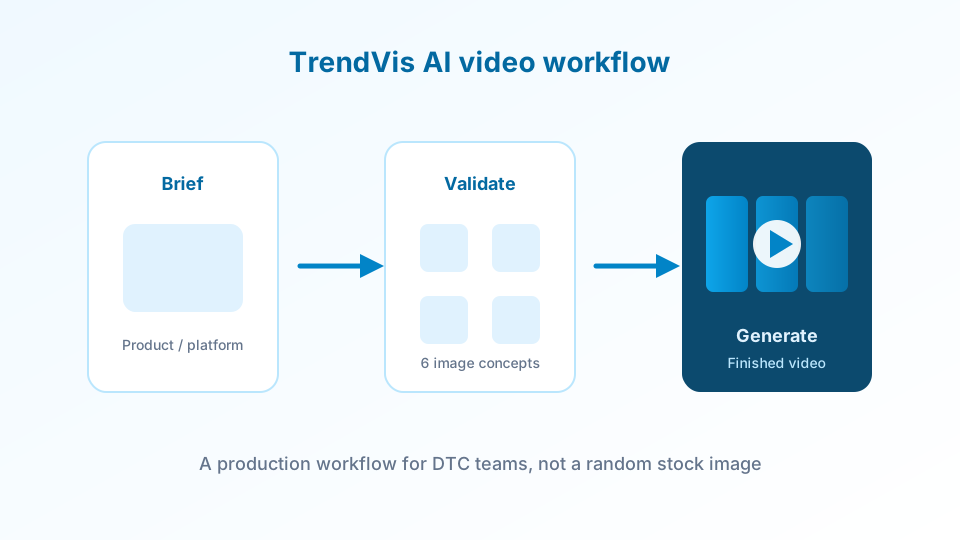
TrendVis turns product briefs into creative angles, validates them as images, then upgrades only the best concept to video.
Start in the studio