Best overall buyer pick
Choose Kling when the first requirement is realistic short motion from a written prompt or image-guided brief. It balances quality, price, and social use well.
Kling is the practical top pick.
Best Text-to-Video AI
TL;DR: the best text-to-video AI in 2026 is Kling for realistic short motion, Runway for editing control, Luma for transparent multi-model cost planning, Seedance for reference-led quality, and Wan for open local workflows.
Sora still belongs in the discussion because it shaped buyer expectations, but it is no longer a normal production recommendation on June 17, 2026. OpenAI says the Sora web and app experiences were discontinued on April 26, 2026, and the API is scheduled to shut down on September 24, 2026.
That changes the ranking. A good 2026 text-to-video choice must be available, priced clearly enough to plan, strong enough for short commercial output, and practical enough to turn a written brief into a usable clip without endless retries.
Direct answer
The best text-to-video AI in 2026 is Kling for realistic motion, Runway for a complete creative workspace, Luma for clear credit planning, Seedance for multimodal reference control, Pika for fast social clips, Hailuo for low-cost tests, and Wan for open workflows. Avoid new Sora production plans.
The best text-to-video AI in 2026 is Kling for realistic motion, Runway for a complete creative workspace, Luma for clear credit planning, Seedance for multimodal reference control, Pika for fast social clips, Hailuo for low-cost tests, and Wan for open workflows. Avoid new Sora production plans.
| Plan or route | Cost signal | Best for | Caveat |
|---|---|---|---|
| 1. Kling AI | VIDEO 3.0 no audio is listed at 6 credits per second for 720p and 8 credits per second for 1080p | Realistic short motion, image-to-video, product movement, fashion, people, lifestyle clips, and social ads | Prompting must stay focused, and native audio raises credit cost. |
| 2. Runway | Free has 125 one-time credits; Standard is $12 monthly annual with 625 monthly credits | Text-to-video plus editing, asset management, apps, audio, and a broader creative workspace | More control can mean more decisions and more credit spend. |
| 3. Luma | Plus is $30 monthly, Pro is $90, Ultra is $300, with published credit tables for models and resolutions | Teams comparing Ray, Kling, Seedance, Veo, and other routes with visible cost math | High-resolution and long clips become expensive quickly. |
| 4. Seedance | ByteDance positions Seedance 2.0 around multimodal audio-video generation and director-level reference control | Reference-led scenes, cinematic control, motion stability, and input mixes with images, audio, or video | Direct buying paths and provider pricing can vary by region and platform. |
| 5. Pika | Pika lists Free, Basic, Standard, Pro, and Fancy tiers, with video credits and Pika 2.5 access by plan | Fast social clips, effects-led videos, creator formats, memes, and quick short-form variants | Not always the best pick for premium realism or controlled long-form scenes. |
| 6. Hailuo | MiniMax video packages list unit deductions for Hailuo 2.3 Fast and Hailuo 02 by resolution and duration | Low-cost tests, fast social clips, and model routes where failure does not deduct units | App and API pricing may not match, so choose the route before budgeting. |
| 7. Wan | Wan2.2 is open and supports text-to-video and image-to-video at 480p and 720p through released weights | Technical teams, local workflows, open research, and custom video pipelines | The 14B routes require serious GPU resources, while smaller routes trade quality for access. |
| 8. Sora | OpenAI says Sora web and app were discontinued April 26, 2026, with API shutdown set for September 24, 2026 | Existing Sora users exporting old work or winding down legacy API integrations | Do not start a new production workflow on a discontinued product path. |
Choose Kling when the first requirement is realistic short motion from a written prompt or image-guided brief. It balances quality, price, and social use well.
Kling is the practical top pick.
Choose Runway when generation is only one part of the job. The editor, apps, storage, and team workflow can matter more than raw model output.
Runway is the production workspace pick.
Choose Wan when your team can run open models and wants control over infrastructure, research, fine-tuning experiments, or custom pipelines.
Wan is the builder pick.
Write the product, subject, action, camera move, duration, and platform before choosing a model. Text-to-video fails fastest when the brief is vague.
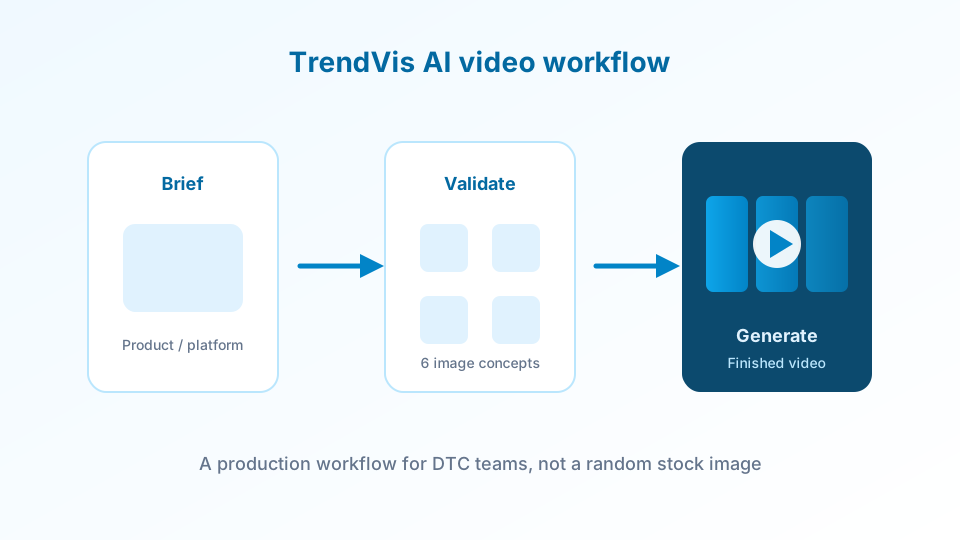
Even on a text-to-video project, a reference image can lock the product and composition. TrendVis uses still validation to reduce wasted video attempts.
Monthly price is less important than how many attempts produce one publishable video. Track retries, resolution, duration, and failed generations.
Sora remains important historically, but the 2026 buyer decision should favor available tools with clear support and current pricing.
Kling is the best practical first pick for realistic short motion. Runway is best for a full creative workspace, Luma for visible cost planning, Seedance for reference-led quality, Pika for social clips, Hailuo for low-cost tests, and Wan for open workflows.
No for normal web and app use. OpenAI says the Sora web and app experiences were discontinued on April 26, 2026, and the Sora API is scheduled to be discontinued on September 24, 2026.
The cheapest tool depends on duration, resolution, retries, and whether failures consume credits. Hailuo, Wan, Pika, and lower-resolution Kling routes can be cost-effective for tests.
Use image-to-video when product accuracy matters because a reference frame locks the subject and layout. Use text-to-video when the scene is exploratory and the model can invent the visual world.
TrendVis turns product briefs into creative angles, validates them as images, then upgrades only the best concept to video.
Start in the studio