Best value plan
Plus is the safest first paid step when you need real commercial tests but do not yet know your retry rate. It gives enough room to learn the model before upgrading.
Start with Plus unless usage is already known.
Luma AI Pricing
TL;DR: Luma pricing in 2026 is best understood as a credit system: Plus starts at $30 monthly, Pro at $90, Ultra at $300, and actual video cost depends on model, resolution, duration, and route.
The old Dream Machine brand still matters to searchers, but Luma now presents a broader creative platform with Ray models, partner models, image tools, video-to-video, reframe, and API surfaces. That makes plan price only the first number to check.
For buyer decisions, the important question is not whether Luma is cheap. It is whether Luma gives you enough transparent credit math to choose between Ray, Kling, Seedance, Veo, and other routes before you commit to a render.
This guide breaks down the Luma plan ladder, how credits are consumed, how Luma compares with Runway and Kling, and when teams should validate still frames before burning high-resolution video credits.
Direct answer
Luma AI pricing is strongest for teams that value clear credit tables and multi-model routing. Plus is the practical entry point, Pro fits recurring production, and Ultra is for heavy usage. Runway is better for editing workflow, Kling can be simpler for realistic short motion, and buyers should validate concepts before spending high-resolution video credits.
Luma AI pricing is strongest for teams that value clear credit tables and multi-model routing. Plus is the practical entry point, Pro fits recurring production, and Ultra is for heavy usage. Runway is better for editing workflow, Kling can be simpler for realistic short motion, and buyers should validate concepts before spending high-resolution video credits.
| Plan or route | Cost signal | Best for | Caveat |
|---|---|---|---|
| Luma free access | Luma lets users try the platform before choosing a paid plan, but free capacity is limited | First tests, interface evaluation, prompt feel, and deciding whether Luma quality fits your creative taste | Do not plan recurring commercial output around a trial path. |
| Plus | Luma lists Plus at $30 monthly or $300 yearly for individuals | Solo creators and small teams testing Ray, image generation, and occasional short video projects | High-resolution video can consume credits quickly if every concept starts as video. |
| Pro | Luma lists Pro at $90 monthly or $900 yearly, framed around higher usage than Plus | Recurring creators, agencies, and teams making video every week | Pro is still not unlimited; failed or exploratory generations must be budgeted. |
| Ultra | Luma lists Ultra at $300 monthly or $3,000 yearly for heavy usage | Studios, content teams, and agencies producing many variants or high-resolution outputs | Ultra only makes sense if your team has a process for choosing the best concepts. |
| Ray video credits | Luma publishes credit costs by model, route, resolution, duration, and video-to-video or reframe task | Teams that want to estimate cost before choosing 540p, 720p, 1080p, HDR, or video-to-video | The same prompt can become much more expensive when resolution, HDR, or route changes. |
| Versus Runway | Runway starts lower on web plans and emphasizes a production workspace plus API pricing | Editors and teams that need tools around the generation, not just model access | Runway credit math and app workflow may be less transparent for pure model comparisons. |
| Versus Kling | Kling publishes per-second VIDEO 3.0 costs by resolution and audio mode | Straightforward realistic short motion and image-to-video product clips | Luma is better when comparing multiple model routes in one credit table. |
Plus is the safest first paid step when you need real commercial tests but do not yet know your retry rate. It gives enough room to learn the model before upgrading.
Start with Plus unless usage is already known.
Pro fits teams with weekly video needs, especially if they validate stills first and reserve video credits for concepts that already match the brand.
Pro works when workflow discipline is in place.
Ultra is for teams producing many variants, high-resolution outputs, or client work. It pays off only when briefs, reviews, and approvals prevent endless rendering.
High usage needs stronger selection rules.
Before rendering, choose model, resolution, duration, and whether the task is text-to-video, image-to-video, video-to-video, or reframe. Each choice changes credit burn.
Use static images to test product framing, background, and hook before video. This is the easiest way to keep Luma credits for ideas that have already passed a visual screen.
Luma may win on transparent routing, Kling may win on motion value, and Runway may win on editing workflow. Run one brief through each before buying a higher plan.
Plan price is less important than usable output. Record attempts, final exports, rejected generations, and editing time so your next plan decision is based on real throughput.
Luma lists Plus at $30 monthly, Pro at $90 monthly, and Ultra at $300 monthly, with yearly options. The true video cost also depends on credits, model, resolution, route, and duration.
Luma allows users to try the platform before choosing a paid plan, but limited free access should be treated as evaluation capacity rather than a production plan.
It depends on the route. Luma can be easier to budget because it publishes model credit tables, while Kling may be simpler for short motion and Runway may be better when editing tools are needed.
Validate the idea as a still image, render short lower-resolution tests first, compare model routes, and upgrade to longer or higher-resolution video only after the motion works.
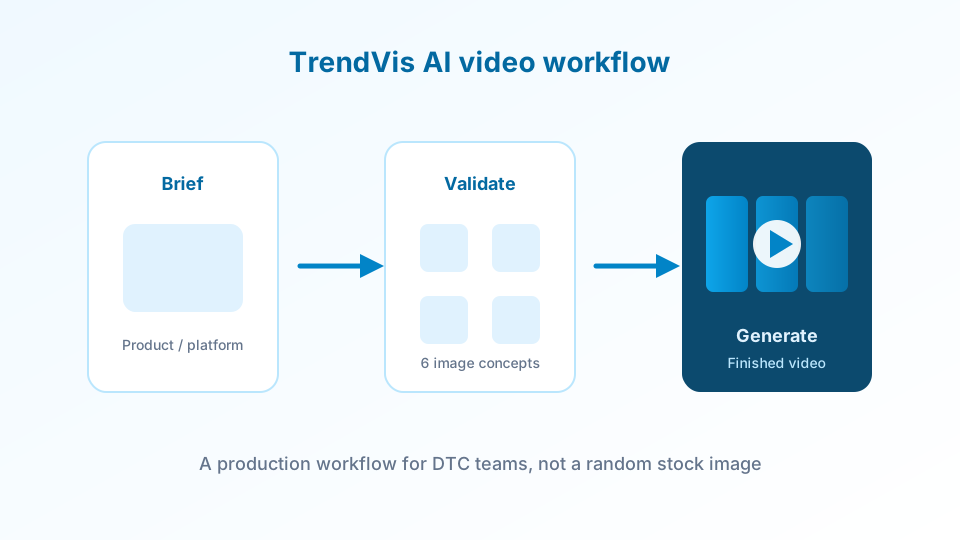
TrendVis turns product briefs into creative angles, validates them as images, then upgrades only the best concept to video.
Start in the studio