Best default API
Choose Runway first when the team values documentation, examples, model references, and a familiar commercial vendor. It is a strong baseline for production readiness.
Runway is the documentation-led pick.
AI Video Generator API
TL;DR: the best AI video generator API in 2026 depends on the job: Runway is strongest for developer docs and production polish, Luma for cinematic routing, Kling for realistic motion, Hailuo for cost-aware tests, and Wan for Alibaba Cloud or open-model builders.
Video APIs are harder to compare than image APIs because the real cost includes duration, resolution, queue time, retries, failed jobs, moderation, storage, callbacks, and whether the model can keep a product or character stable across frames.
A good API decision starts with the workflow. If you are building a product, docs and reliability may matter more than the prettiest demo. If you are building internal creative automation, cost per usable clip may matter more than one perfect render.
This guide compares Kling API, Runway API, Luma API, Hailuo API, and Wan API by price signals, speed, limits, documentation quality, and the kind of video product each route supports best.
Direct answer
Runway is the safest first API for teams that prioritize documentation and production workflow. Luma is strongest for cinematic model routing and transparent credit planning. Kling is compelling for realistic motion. Hailuo is useful for cheaper tests. Wan is the builder pick when Alibaba Cloud or open video models fit the architecture.
Runway is the safest first API for teams that prioritize documentation and production workflow. Luma is strongest for cinematic model routing and transparent credit planning. Kling is compelling for realistic motion. Hailuo is useful for cheaper tests. Wan is the builder pick when Alibaba Cloud or open video models fit the architecture.
| Plan or route | Cost signal | Best for | Caveat |
|---|---|---|---|
| Runway API | Developer docs price credits at $0.01 per credit and list model-specific video costs | Production apps, teams needing clear docs, predictable developer workflow, and creative-suite credibility | Costs rise with high-quality models and longer outputs, so retry tracking is essential. |
| Luma API | Luma positions Ray3.2 API for cinematic-grade generation at scale | Creative products, agencies, cinematic tools, and teams that want Luma model quality in their own app | API pricing and consumer subscription pricing should be treated as separate budgets. |
| Kling API | Kling API providers expose text-to-video and image-to-video with model and credit differences by route | Realistic motion, image-to-video, product action, character movement, and short-form video apps | Confirm whether you are using official, regional, or third-party access before budgeting. |
| MiniMax Hailuo API | MiniMax publishes pay-as-you-go Hailuo video prices by resolution and duration | Cost-sensitive tests, fast social generation, and apps where failed attempts should stay cheap | Quality and control may not match premium cinematic routes for hero content. |
| Alibaba Wan API | Alibaba Cloud documents Wan text-to-video API access through DashScope SDK or HTTP | Alibaba Cloud users, global or China-region deployments, and teams comparing hosted Wan with open Wan | Region, endpoint, account, async polling, and model selection require careful implementation. |
| Pika via Fal | Pika says its API is available through Fal.ai | Fun social effects, creator tools, and fast animation features rather than enterprise video infrastructure | Use it when Pika effects are the product feature, not when you need broad model control. |
Choose Runway first when the team values documentation, examples, model references, and a familiar commercial vendor. It is a strong baseline for production readiness.
Runway is the documentation-led pick.
Choose Luma when the product needs cinematic quality and the ability to reason about multiple model routes and credit costs in one ecosystem.
Luma is the routing and quality pick.
Choose Hailuo or a lower-cost Kling route for early idea validation. Save premium model spend for prompts that already pass product and motion checks.
Cheap tests protect expensive renders.
Write down duration, resolution, aspect ratio, input type, callback behavior, moderation needs, storage rules, and expected failure handling before choosing a vendor.
Video generation is asynchronous. Test task creation, polling, retry policy, timeout behavior, failed generation billing, and webhook recovery before building UI.
The cheapest API is not always cheapest if users need five retries. Track cost per accepted clip, not just cost per request.
Store model-neutral creative briefs separately from vendor-specific parameters. That makes it easier to switch from Hailuo to Kling, Luma, Runway, or Wan later.
Runway is the best default for documentation and production workflow, Luma is strong for cinematic routing, Kling for realistic motion, Hailuo for lower-cost tests, and Wan for Alibaba Cloud or open-model builders.
Hailuo and lower-cost model routes can be cheap for tests, but the real price is cost per usable clip. Failed renders, retries, duration, and resolution often matter more than the headline rate.
Yes, Kling API access exists through documented provider routes for text-to-video and image-to-video. Confirm whether your chosen endpoint is official, regional, or third-party before building around it.
Start with input type, output duration, quality target, callback design, documentation quality, failure billing, and vendor stability. Then run the same brief through two or three APIs.
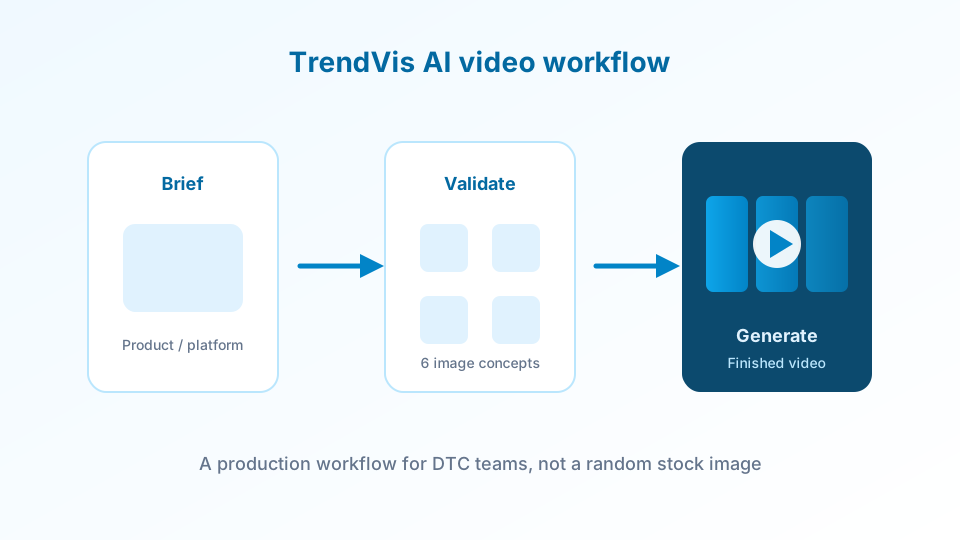
TrendVis turns product briefs into creative angles, validates them as images, then upgrades only the best concept to video.
Start in the studio